Sparking Change: Seen, Anonymously
Ted Bongiovanni
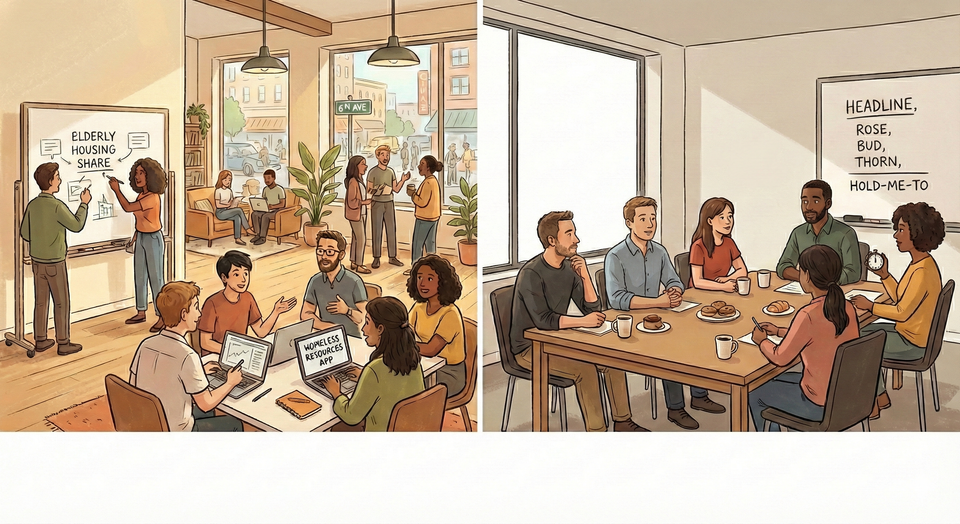
Almost a decade ago, thanks to working at Consumer Reports, I got to use a co-working space called Civic Hall. Unlike the corporate WeWorks which felt anonymous and sterile, Civic Hall bustled with conversations, warmth and energy. Everyone was working on some sort of transformative project—matching elderly NYC residents who had extra rooms with young city transplants, a live-streaming platform for activists, designing ways to connect homeless people with resources by interviewing homeless people.
Civic Hall was more than just a place to work; it was a community of communities. One of them was called WeSparq: a group that met weekly, ostensibly for "accountability."
Why would anyone sign up for that? It turns out that having a group of folks that aren’t your co-workers is a great way to be seen, heard and hold you to account for the things you want to accomplish.
I watched this group meet like clockwork every Friday at 9am in one of the spartan conference rooms. There was usually improvised food, always coffee. I was curious. I gravitated to the bank of windows facing Sixth Avenue, and so did one of the WeSparq folks, Dorian, who sported a uniform of charcoal pants and an indigo button down that reminded me of my Catholic school days. Over coffee and impromptu lunches, he told me about the group and eventually asked if I wanted to try it out. "Friday, 9am. Treat it like a business meeting. See if it's for you."
I was skeptical. My calendar was already packed with meetings, and I didn't lack accountability structures—I had a team, a boss, sprint planning, JIRA, all of it. Still, I agreed to try a session or two.
The format is deceptively simple. A facilitator (called a marshall) keeps time. Everyone gets two or three minutes to review their week: Headline, Rose, Bud, Thorn, Hold-Me-To (a commitment you’re making to get done in the next week.). Someone always takes notes for you, not so you can review them later, but because being listened to changes what you say. After everyone checks in, the group spends the remaining time on a "hot seat" topic driven by whoever needs it: working through a thorny problem, pressure-testing a business strategy, sometimes just talking about why a meditation practice matters.
Here's what I didn't expect: there's a particular kind of freedom in being known by people who have no stake in your work. You're not managing up or managing down. There's no need to sugarcoat. You're both seen and anonymous. That paradox is part of the magic, and it builds over time.
The group's composition has shifted over the years—some folks joining, some moving on. The only real criterion is committing to the hour and being willing to listen, share, and support. That support takes different forms: a question that helps someone get clear, noticing when something's been stuck for a while, offering a deeper conversation from your own expertise.
I credit WeSparq with helping me take a risk I might have avoided. Adam, one of the group members, challenged me directly: "Ted, you should be running an organization." I might have thought that privately, but hearing someone else see it—and say it—made it real enough to act on. I took that job. I'm in a much more senior leadership role now. I suspect without WeSparq, I would have let the opportunity pass.
Dorian and I have been thinking about what made this work—and whether it could work for others. We're starting to document what we've learned: the structure, the roles, the unwritten rules that matter more than the written ones. If you're curious about starting something like this with your own people, we'd love to hear from you.